

Biologists note that bigger species are better at capturing prey, they can travel longer distances and support bigger brains. Economy of scale is something biology has known for hundreds of millions of years. So why hasn't evolution made every species freaking huge? To quote Aaron Clauset of the Santa Fe Institute and Doug Erwin of the Museum of Natural History, "The tendency for evolution to create larger species is counterbalanced by the tendency of extinction to kill off larger species."
To quote Morgan Housel writing for the Collaborative Fund "Body size in biology is like leverage in investing: It accentuates the gains but amplifies the losses. It works well for a while and then backfires spectacularly at the point where the benefits are nice, but the losses are lethal."
Bugs can fall from heights thousands of times their own height with little to no damage. Small rodents may be 50 times. A human is done it they fall from 10 times their height. An elephant: twice its height and it is history.
Big animals require more of everything: land, and food. Food is why the larger animals fail during famine. They have other drawbacks; can't hide easily, move slowly, reproduce slowly. The biggest advantage is their best and worse: being at the top of the food chain status means they usually don't need to adapt, but very bad when adapting is required. That is why the cockroach, and bacteria will be here long after we are gone, and why dinosaurs disappeared 65 million years ago.
Large companies that could not adapt: Sears, Kodak, Blockbusters, Polaroid, Toys R us, Pan Am, Borders, Tower Records, Radio Shack.
Blockbusters, Toys R Us, and Radio Shack failed because they ignored the Internet. Sears was an early explorer when it came to online sales. But it gained a reputation for not caring for its employees, which showed in its stores. Things got worse and human nature took over, no one wants to be associated with or do business with failure. In the case of Pan Am the market environment changed and it didn't. Kodak and Polaroid, held on too long to technologies they pioneered and would not compete against newer ideas.
As we know being first does not guarantee success. Just look at Myspace and Yahoo!. A failure that was very close to where the business is going today was the squandering of $99 billion that happened when AOL and Time Warner merged. The timing was bad, right before the dot-com bubble burst. AOL shareholders owned 55 percent of the combined company while Time Warner shareholders owned 45 percent. AOL's co-founder, chairman and chief executive officer, Steve Case, became chairman of the new company, while Time Warner chairman and CEO Gerald Levin was named its CEO.
The behemoth, $350 billion at the time of the merger, mega-corporation was created at the beginning of 2000 when the two merged. AOL had an early online audience, and Time Warner had a television audience. In theory the company should have dominated in every type of media, including music, publishing, news, entertainment, cable, and the Internet. AOL's valuation was more valuable in market cap terms than many blue chips stocks.
Even though they merged officially, that never happened operationally. It appeared that no one did any due diligence as to whether the two cultures would mesh. The aggressive and, many said, egotistical and condescending AOL people appalled the more sedate and corporate Time Warner side. Cooperation and promised synergies failed to materialize as mutual disrespect came to dominate their relationships.
Two things led to the company's eventual demise. The dotcom bubble burst, and the economy went into a recession. Advertising dollars dried up. The second was technology. While AOL was the king of the dial-up Internet world, it was rapidly being supplanted by always-on, and much faster broadband. At the time of the merger, half the country had Internet access, but only 3% had broadband. AOL's business model was based on payment for a monthly dial up subscription. Starting in the 2000s a business Time Warner was already in, cable, was rapidly eating into the need for AOL's part of the business.
In 2002, AOL Time Warner reported a quarterly loss of $54 billion, the largest ever for a U.S. company. In the couple of years after the acquisition AOL's value fell by 90%. Time Warner spun off AOL in 2009 for pennies on the dollar. Levin, was widely blamed by shareholders for allowing Time Warner and its stable old-media assets to be effectively taken over and dragged down by the ailing new-media division, resigned in December 2001. In 2018, AT&T acquired Time Warner.
We just saw how Thomson thought economies of scale would make them more efficient. Economic evolution pushed them in that direction, so they could bring more value to the stockholders. But when is it too big? When do economies of scale become self-destructive? Thomson was well on its way to being the dominant force in it's industry. But it bought its size through leverage. When the economy was good, and stable, it seemed like a great idea. When world-wide valuations crashed starting in 2008, it became a house of cards. Many thought the Thomson saga was mainly due to bad luck or timing.
The kind of corporate culture that lets companies dominate an industry is not friendly to people who say, "I think we've grown too fast. Maybe we should scale back." They'll keep pushing until they're forced to make painful cuts.
They say that someone with a 110 IQ, but the ability to recognize when the world changes, will always beat the person with a 140 IQ and rigid beliefs. You can have a penthouse full of smart people running a company whose knowledge was acquired 20 or 30 years ago when the rules of the game were dramatically different. That acquired knowledge was gained at a cost of money, time, ward work, and humiliation. That is a sunk cost that you don't want to write off easily as people tend to cling to what they already know.
Marc Andreessen, co-author of the first widely used web browser, Mosaic, a co-founder of Netscape, and co-founder and general partner of Silicon Valley venture capital firm Andreessen Horowitz, encourages the idea of "strong beliefs, weakly held." That is the ability to focus on an idea but having the humility to let it go when its proven wrong.

John Stroup found himself as the CEO at a fat lazy Midwest (St. Louis) industrial manufacturing company called Belden in 2005. Before joining Belden, he worked as a senior executive for a company called Danaher, and he was responsible for global business operations around the world. In the small world department, that is the company that bought Tek in 2007.
Stroup was able to increase the efficiency and profitability of the company. He managed to get Belden's share price up, but he could only go so far unless he found a way to greatly increase sales, and Belden had a significant share of the cable business already. The other option was to expand the company. Belden was sitting on a pile of cash, and Wall Street wanted him to do something with it. The standard rule of business is you invest in what's adjacent to you. Again, size should yield synergy. The sales force should become more efficient with more products to offer, along with all the back-office savings. You are selling more products to the same customers, and at the same time selling the same product to different customers.
So, he started to expand Belden into the markets that they already served. He considered their markets as enterprise, industrial and broadcast. In the broadcast arena, they got excited about the idea of getting more involved in active components. And just like many broadcast vendors, Belden considered itself a high-mix, low-volume company, and a strong commitment to lean manufacturing, so almost everything they make was built to order.
Belden broke out of its wire and cable mold with the 2007 acquisition of Ethernet switch maker Hirshmann. It made industrial Ethernet switches used for automation. Two years later it bought a company much better known to broadcasters, Telecast. The company was a supplier of fiber conversion products for news gathering (ENG), and venue infrastructures. In 2011, it acquired ICM Corporation, a broadcast connectivity company, and the broadcast networking part of Thomas & Betts.

In July 2012 it made its first big acquisition as it started its run up to do what Thomson tried but failed doing. It brought Miranda, which began as a small Montreal-based broadcast technology provider in 1989. There was only a four-month courtship before the deal was finalized. Compared to other companies in the business, Miranda had seen a respectable increase in revenue, and was doing well in emerging markets in Asia. Strath Goodship, a former Miranda CEO, was brought back to lead Miranda. Belden kept the Miranda brand name. Miranda at the time was a $200 million a year in revenue company.

Denis Suggs, executive vice president for the Belden Americas Group, oversaw the acquisition. The acquisition made Belden a $2 billion business. It was founded in 1902 and had sold cable to the broadcast industry since 1932. As a cable alone business it was $1.4 billion a year, of which $50 million in cable were sold to broadcasters. Suddenly in 2012 their broadcast business was almost $300 million.
As became a theme, Miranda was an important investment to the local teacher's union, and the Quebec province, who looked upon Miranda as a job creation entity. Soon after Miranda bought NVISION in 2008, as we will saw in the article the Only Spinoff, they moved NVISION's PCB fab and manufacturing facilities to Montreal. So almost immediately Miranda convinced Belden to move Telecast's manufacturing, which was out of Worcester, MA, to Miranda's Quebec, manufacturing facilities. Telecast's products also became a product line within the Miranda portfolio. Telecast Worcester office remained open for sales and service calls, sharing space with Belden's recently acquired Mohawk Cable business.
Goodship said there is "surprisingly little overlap" in products between the two companies. In fact, Miranda had attempted to produce fiber conversion products several years before "and failed," according to Goodship. Telecast also had a loyal following among the mobile truck community.
Belden did well with the Miranda acquisition, as by the beginning of 2014 Belden stock had doubled.

In March of 2014 it became GV's turn. Belden bought GV from Francisco Partners and immediately merged with Miranda. Marco Lopez was the president of Miranda at the time, and he became the President of the combined GV/Miranda company. Interestingly the GV brand was kept, and the Miranda brand retired. But in tribute to the part of the company that controlled the company but lost its own name to a small town in California, Miranda's magenta color scheme replaced Grass Valley's green theme.
With the acquisition of Grass Valley, the percentage of revenue from cable products for Belden was about 35 percent. When Stroup joined the company in 2005, it was almost the entire company. By 2015 Belden was a $2.4 billion company. Broadcast accounted for about $1 billion of the company's revenue.
Miranda and Grass Valley had some overlap, but each had products, and strengths the other didn't have. Belden's video business went from $200 million to $500 million. At the time Stroup was still talking about economies of scale.
The Miranda product line was heavier in routing (thanks to NVISION), playout, multiviewers, monitors, graphics, and branding, while Grass Valley focused more on production switchers, automation and editing, servers, cameras, and camera systems. In theory this broad product offering makes things easier for their customers. Smaller vendors would have to pursue a best-of-breed route, selling niche products. Customers going this route are vulnerable to one piece of their puzzle failing, either by a financial issue with the vendor, or simply a technology snafu. The fact that Belden was financially stable and the additional support of Miranda, made many customers, especially the mobile production truck vendors who were heavily committed to GV, feel better.
While Belden had St. Louis as their headquarters, it was a small office, of about 40 financial people, the legal team, and the human resources staff. Their manufacturing was all over the world, United States, Canada, Mexico, China, Brazil, Germany, Czech Republic, United Kingdom, France, Netherlands. They tended to build products close to consumption. So, Belden was quite comfortable with managing a global enterprise.
The headquarters of the combined companies ended up in Montreal. There was no chance at that point that Grass Valley would ever see the corporate HQ located in the area ever again. Francisco Partners originally ran GV from San Francisco and then moved it to Oregon. While GV was the larger of the two companies it was already scattered around the globe, with only a small percentage still in the Grass Valley area. In addition, Belden had a facility near Miranda's and thus they were familiar with Miranda's operation. Quebec also had big tax incentives to be there. By the time Grass Valley was merged with Miranda, Grass Valley had no manufacturing left in the Grass Valley area.
Some GV employees were moved. Mark Hilton moved to Montreal for a year for the modular products, now being built there. He moved back to Grass Valley, as one of the dwindling number of employees there, and in 2017 he then took over as VP of the Live Group. This included cameras, switchers, and replay. Cameras are built in Bretta, Netherlands, and replay was based on the K2, which was developed up in Oregon, and evolved out of the Profile. As Grass Valley continued to downsize in their namesake area, Mark was left go in 2019.
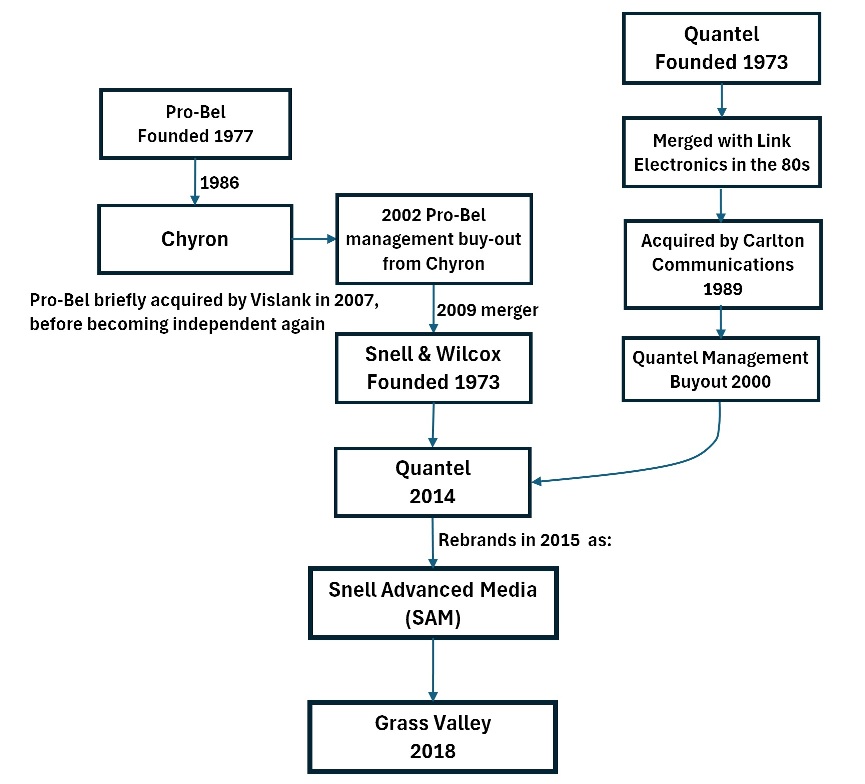
There is one major player not shown on this graphic. That is Llyods Development Capital (LDC). Alot of the business transactions depicted were financed by them.
But Belden still was not done. In February of 2018 Snell & Wilcox was acquired. The Newbury, U.K. company had been founded by Roderick Snell, in 1973. It had re-branded as Snell Advanced Media or SAM. Many of its product lines overlapped with GV's. But somethings Snell was deemed to do better. With the acquisition of SAM the focus moved from the K2 replay system headquartered in Beaverton to theirs.
SAM was an outgrowth of a 2009 merger of Snell & Wilcox and Pro-Bel, another U.K. company. The resulting company took the name Snell. Pro-Bel developed automation, media management and master control technology as well as routing, control and signal modular products. Snell & Wilcox developed systems for video playout, mastering, repurposing, live production switching, and it also did signal modular products.
In March 2014 it was announced that Snell had been acquired by Quantel and the combined company took the name SAM. Quantel made its name in the graphics arena. Introduced in 1981 the Quantel Paintbox was a dedicated computer graphics workstation for composition of broadcast television video and graphics. Its design emphasized the studio workflow efficiency required for live news production. It had a price of about $250,000 per unit (equivalent to $374,000 in 2020). Launched nine years before the release of Adobe Photoshop there was nothing else to touch it performance wise at the time. What the Paintbox offered would have been impossible without expensive, cumbersome, and dedicated hardware. The Paintbox was still going strong into the 1990s.
Ahead of its time in capability Quantel's entry into the DVE market in 1982 was the Mirage. It could warp a live video stream by texture mapping it onto a three-dimensional shape. Not possible until then. In 1985 Quantel introduced the first of their series of "H" non-linear editors, Harry, followed by Harriet in 1990, and Henry in 1992. Quantel products were always proudly situated at the very high end. The cost of spending a couple hours in a Henry editing suite in the 90s would buy you a computer fully loaded with software today that would deliver the same results.
Quantel reached their peak with the Pablo, a color correcting tool which James Cameron used to post produce the 3D Avatar movie in 2009. The Pablo was followed by the Pablo Rio, a complete color correcting and finishing system.
Despite becoming the industry standard for TV graphics and post production, with hundreds sold around the world, the company began to stagger from 2005 onwards. So, in 2014 it acquired SAM. SAM was another British high-end hardware-based manufacturer, famous for their Alchemist standards converter. SAM also had a loyal following with their own line of high-end production switchers.
After the departure of Quantel's CEO Ray Cross, Tim Thorsteinson was appointed CEO in February 2015, until June 2017 when it was announced that Tim Thorsteinson was stepping down as CEO and being replaced with Eric Cooney.
It is reported that Tim stepped down because of health issues. He came close to being there to sell SAM to GV. What a convoluted tale that would be. How many people can sell a company more than once and then sell another to the company he sold? Actually in this series of articles there are more than one who have sold the same company more than once.
In January 2018 Tim Shoulders became GV president, and subsequently moved to Montreal. He has a Bachelor of Arts in Finance and Accounting from Ball State University and joined Belden in 2011. He led Belden's global Broadcast AV Cable business as vice president/general manager and then served in the same role for the global Industrial Cable business. He was known in the company as a merger and acquisition specialist. It looked like the whole GV traveling circus was on the block again.
With SAM now incorporated into the "Group," Grass Valley continued to be headquartered in Montreal. Eric Cooney, former president, and CEO of SAM stayed on in an advisory role. The SAM brand was retired but many of its products are still offered under the GV brand.

By June 2015 what was left of the company in the Grass Valley area was consolidated into what was originally the NVISION building after completion of a $3 million renovation of the building. It was redesigned to house 200 people. The company moved out of the Providence Mine site, and effectively moved back to its namesake town, and out of Nevada City. It had not been since the early 60s that the Grass Valley Company was actually in Grass Valley proper. Now it was, but it would turn out not to last.
At the time the area was happy and proud that the world-renowned company would stay in the area. Some in the area liked to think of Nevada County as "Video Valley" due to the technology cluster of other video companies. "I think it's very nice to have Grass Valley back in Grass Valley," said Grass Valley Mayor at the time Jason Fouyer in a cheerful ribbon-cutting ceremony before about 150 workers, contractors, city and county officials and residents. "They have the entire world they could have moved to, and they chose to keep it here." A bit glib seeing that the company's building was a mere outpost of the company at that point. And the signs were still bad and growing worse. The Providence Mine Site at its height had 400 based there. Now there were about 120 in the former NVISION building.
About that time the company decided to combine engineering and strategic marketing groups into product units. The term divisions were dropped. There were four:
Notice that Grass Valley only shows up twice. No manufacturing, only engineering support and development.
Almost all of the other major acquisitions along the way are still represented from an engineering and development standpoint.
Quantel-SAM acquisition is well represented in Newbury:
Replay, Servers, Storage, & Recorders, Integrated Playout, Master Control & Branding, Transmission servers & Storage, Multiviewers, Routers, Monitoring & Control
Also from Quantel-SAM , Castle Donington, Derbyshire, United Kingdom, Integrated Playout
The piece that Tek left behind in Hillsboro:
Replay, Video Production and Content Management, Automated Productions, Servers, Storage, & Recorders, Transmission servers & Storage
The Miranda part of the deal in Montreal:
Automated Productions, Master Control & Branding, Signal Processing, Multiviewers, Monitoring & Control, including most of the anufacturing
Philips, which came by way of Thomson in Bergschot, Breda, Netherlands
Cameras, and Fiber Transport
Philips also, Weiterstadt, Germany
Video Production and Content Management
Canopus Edius Editor, which also came via Thomson in Kobe, Japan
Editing and Transcoding, Servers, Storage, & Recorders
The first acquired facility to be totally eliminated was the BTS complex in Salt Lake City which came via Thomson and was originally the Telemation plant. It supported the Jupiter router control system, which came to Thomson via BTS, which acquired it from Philips.
The product mix has evolved so that what was a large selection of Grass Valley developed products, but also a lot from those brought into the fold and being sold under the Grass Valley brand. The K2, and Dyno, which was developed up in Oregon and evolved out of the Profile is still offered, but with the acquisition of SAM the focus is now on live touch replay systems built in Newberry.
The Oregon facility still has about 60 people. They're doing asset management, and some server legacy stuff. They're also doing development on newsroom products, along with product family acquired from Parker Vision. There's also still a big service organization up in Oregon.
Besides the production switcher family developed by Grass Valley, a switcher from SAM, the Kahuna is still sold. It sells very well in Europe. There is about a dozen person team in Cambridge UK working on it.
The networking group is now split into two, SAM had a lot to do with this as well. The router unit and the processing unit, which was modular division before.
Router product evolution was generally which acquired company had the newest router offering. Grass Valley was selling the Trinix Router when it was still a standalone company. When they merged with Miranda, the product offered was a router that they had acquired from NVISION. When Probel came into the fold via SAM, its offering became the company's offering. Interestingly Probel and NVISION went head-to-head in a lot of deals earlier.
The only development work done in Grass Valley today is production switcher and some router, but most of the router work is now done in the UK. Grass Valley don't have anything to do with modular. There are about 40 engineers in Grass Valley. Most on switchers, but a few on the routers.
With the final building sold that number will slowly drop through attrition and forced retirements.
A lot of how the company evolved in the late teens of the new century was the oversight that Belden applied through the Miranda management. That forced it to focus on business fundamentals. Belden expected the company to budget how much they were going to sell, and how much profit they would make. GVG could no longer act like a startup and blow out money for future profits. They had to deliver every year, and every quarter.
There's a thing in biology called Dollo's Law that says organisms can never re-evolve to a former state because the path that led to its former state was so complicated that the odds of retracing that exact path round to zero.
Say an animal has horns, and then it evolves to lose its horns. The odds that it will ever evolve to regain its horns are nil, because the path that originally gave it horns was so complex.
There are things that, once lost, will likely never be regained, because the chain of events that created them in the first place can't easily be replicated. If you realize how valuable those things are you'd be more careful about risking their loss.
That will be the Grass Valley Company's and the Grass Valley areas fate. Not horns, but location. How the company came to be in the town of Grass Valley is a major theme of these articles. It took a lot of random events, and a few lucky decisions, and breaks. It won't be back. It became a citizen of globalism. When you bring together companies that each had a standalone infrastructure, the best of breed mentality can take over. Who of the "group" manufactures the best, and most economically, where is the expertise for various engineering functions located? Where are they the friendliest towards business? That would not be California!
As we have seen there were a number of companies that came under the Grass Valley canopy that knew how to produce television routers. You did not need those folks to all reside in a high tax state, an hour and a half from a major airport, with all roads to it only two lanes for a good portion of their length.
Even the original company's legendary prowess with production switchers did not mean others could not develop to be worthy competitors, as SAM did in the U.K. It was that talent located in Grass Valley that kept a presence in the area as long as it did.
Belden got into the equipment vendor space, that is a business space considered adjacent to cable manufacturing, thinking that they could show the television equipment vendors a thing or two when it came to running a lean business. While both Belden and the television equipment vendors they brought, where low volume, high mix, their scales were still a magnitude off. While Belden had a gigantic product catalog, the high mix part, they often created hundreds of miles of a particular cable during a run. Grass Valley, Miranda, SAM, or any of the companies those three had folded up earlier, literally might make a run of four or five production switchers at a time, each with different options. Belden did not stop down every few thousand feet during a cable run to slightly change the cable's parameters.
Just because you move into an adjacent market does not mean you easily transform into acquiring the expertise that is needed to survive there. Boeing designs and assembles complex aircraft. They install engines onto those aircraft, but they do not design or manufacture them. If they decided to compete in the engine market, they would be in for a steep learning curve. Conversely, GE would be in a long term world of hurt if they considered not only building the engine, but the entire plane while they were at it. Both Boeing and GE have a lot of common competencies. It's ones they would have to add that could kill them.
Designing complex hardware and writing/debugging software to make the hardware do something useful is entirely different from designing and building industrial processes to manufacture thousands of miles of various types of wire and cable. Belden's acquisition of GVG is eerily similar to the acquisition of NVISION by ADC in 1999 as we saw earlier. "Same circus, different clowns," as one observer quipped.
Belden thought increased focus around business fundamentals was what was needed. Now you budget how much you're going to sell, and how much profit you're going to make. They wanted GV to stop acting like a startup by blowing out money now, hoping for future profits. They would now have to deliver every year, actually every quarter. In 2015, then Miranda CEO Marco Lopez said, "Broadcast for Belden is 40 percent of revenue," he added. "It's very important." But again, technological forces were gathering to stymie any business logic that Belden thought they could bring to bear.
Every time Belden bought one of these businesses, whether it was SAM or Grass Valley, they came into it thinking and seeing ahead that there were going to be positive market tailwinds that would carry the business through growth. And they could bring the businesses together, lean out the back office functions, lean out the powers in the market, and put it in a position where they could reap the growth upside with a combined stronger portfolio and thus follow the market trend upward.
Well, the market was not really trending upward. As a matter of fact, it followed typical patterns of bouncing up when the big international sporting events occurred, and then falling back. After six years of expecting the market to grow and it does not, you eventually lose patience.
So, it was difficult for GV to give Belden management a good perspective on where the business was going to land in any given quarter, good or bad. Companies like GV lived and died by landing large projects. Often, they would think they have won a project, that either would slip into the next quarter, or slip away entirely.
Jay Kuca remembered, "My good friend and former GVG colleague, the late Bob Johnson, watched the company's sales performance very closely, and he posited that the only "seasonality" he was able to detect was driven by major televised events like the Olympics and the national political conventions. Both of those are on much longer cycles than a calendar quarter."
As we have started to see, and will see in much more detail later, application software can be simple, in which case it sells in someone's app store for $2.99, or it can be complex, and has to mesh with intricate hardware, which it is a part of, or controls it from a far. The challenging thing about software is that customers do not value it as a standalone product. Offer a device that is a mixture of software and hardware, something that you can physically touch, and they might pay thousands of dollars for it. Turn it into a purely software app residing on a PC, tablet, or phone, and they will expect to pay a tenth or less for the same functionality.
Software engineering, of any complexity, is expensive, but OK so long as enough hardware is sold along with it to make it worthwhile. An example as told by Chuck Meyer when he was with NVISION in the 90s: They could produce a modular product that they could sell for something like $1400 in the US. It would have a Bill of Material (BOM) for the hardware that was $300-400. That product would not be a pure hardware item. It would have devices that needed to be coded (FPGAs and the like), and maybe even PROMS with actual software. Creating that software was the expensive part. But the markup was enough to justify the programming talent that the company would need to employ.
In the mid-teens of the new century GV realized that the online video platforms, such as Netflix, Apple, and Amazon were doing two things to broadcasters. One was all the other ways their traditional viewers could receive content. Two was the increased competition for content as those platforms were now competing for content against the local broadcaster, via content that would historically be on network television and was not.
Broadcasters began to face the reality that they would have to use the web to create and distribute content. So, in the background GV started laying the pathway to become a service provider on the web. It was a painful decision but they realized hardware would have to be positioned to be a necessary evil, although a profitable one. But a method would have to be found to make the software bring in more revenue if the industry was not going to revert completely to the likes of Adobe.
Some hardware from GV will be necessary for the foreseeable future. The company introduced a new camera platform, the LDX 100, with native UHD and high-speed frame capability. This camera can be directly interfaced into an IP "contribution" network. They introduced a more powerful K-Frame XP production switcher that handled UHD without impacting the I/O count. As we saw earlier, it was sort of a hybrid project that was starting to divorce the control panel or operating surface from the underlying video processing. An initial step towards moving that processing out into the cloud.
The GV Media Universe, introduced in 2020 an ecosystem of cloud-based tools and services, was introduced. It was built on its Agile Media Processing Platform (AMPP) This was a big step in how they might be able to make software pay. This would help clients spin services up and down either locally or on the web as needed. The basic concept is that software would not be sold as a capital expense, but as an operating expense. People needing production services would not go and buy a lot of expensive hardware but would pay as needed for services in the cloud. The building of on-the-fly "media factories," to match whatever production workflow was required at the time, that would go away after use.
An example given by GV President Tim Shoulders at the time, "The Media Factory can be a set of applications to capture, curate and distribute content and they can be built up for peak capacity on something like the Olympics and then scaled up and down as needed with the client just paying for what they need." Since the service had an HTML interface it would allow for a show to be produced from anywhere, including functions like graphics and replay, that can run on a public or private cloud, or both.
As we will see later the REMI (REMote Integration model) production model was coming online, that allowed customers to reduce travel costs. In 2019 TV Technology said, "what used to require specialized knowledge and lots of rack space now can be done on a laptop." But that will not always be the case as GV President Shoulders at the time said, "I would still argue that doing complex things like switching video over IP, that's rare-few companies have been able to do that successfully. Grass Valley being one of those companies."
All the prep just mentioned did not help the immediate business problem that Belden faced with GV. As we alluded to as 2020 approached there was another format change. But this one was not a video or file format change, but a fundamental business change. The move to Common Off The Shelf (COTS) hardware based around the cloud, after many earlier tries, was finally an approach that now had the legs to stand on its own. As we just mentioned, the mindset was evolving rapidly that software revenue would become a pay as you go revenue stream, and not a "capex" influx of cash. That in the short term was going to greatly hurt cash flow and eliminate any profits for a while. This became a very stressful time for Belden, and they decided to rethink what they had assembled. But as you can imagine, to mitigate the impact of that, they put a lot of pressure on the Grass Valley business anyway. Partially because of the pressure in the halls of Grass Valley/Miranda a saying sprang up - "we don't do it right, we do it right now."
But the conglomerated GV had another pressing issue. It had been assembled from many different companies over time. They had a number of various software stacks and software architecture approaches from various parts of the portfolio. This integration was going to take time. Going through that transition and hitting quarterly revenue performance targets set by Belden just could not happen.
Belden had hoped that the transition could have been complete a couple years sooner than it took.
The products they had developed over the last few years allowed a strategy to develop to give Belden a way out. No, not a way to profitability, but a strategy to sell the company. On October 30, 2019, Belden publicly announced that it would divest the "Live Media business." AKA Grass Valley. Stroup had to find a buyer as he was under pressure because his investments in video did not allow them to make their numbers.
The company decided to fully embrace the direction that they were generally headed. They overtly pushed the Software As A Service (SAAS) business model. The company would assemble and position their products to sell production services through the cloud and would reap whatever hardware sales they could in the process. It was this sales pitch, and the GV brand, not as shiny as it once was, but still brighter than most, that got them bought. But it would have to be by someone who could take the long view. We will look more in depth at SAAS later.
That year they had a good year for switchers. But in a sign of things to come their sales of IP products were up almost 100% over the prior year, poised to double again the next year. So, the inflection point for IP was at hand. And that meant that as their customers went the IP route, a larger percentage of the remaining hardware sold was COTS, not money that would flow through GV.
Companies like GV typically do not carry a deep order backlog outside of service support agreements, and so can't be sure what the quarter would bring, and a lot of sales activity compresses around the end of the quarter. Belden had a track record of being very good at forecasting the cycles of the cable business and for the reasons stated were never able to figure out how to properly forecast Grass Valley.
The final year that Belden owned GV the financials were bleak. The company was on track to lose over a billion dollars on sales of about $2.5 billion, of which about $348 million in revenue were from GV. If GV numbers were backed out the company made a profit. Losses due to GV increased threefold over those of 2018. Like what Tektronix had experienced.
"Revenues were near the midpoint of our expected range excluding Grass Valley," said Stroup at the time. "Consistent with our expectations, demand trends remained softer in some of our key industrial markets in the third quarter, but we are encouraged by the improving trends in our broadband business."
The negatives upstaged the positives and so the board of directors of Belden decided on Wednesday, October 30, 2019, it was time to divest. Many GV customers took this latest sale in stride, as they had gotten used to the company being treated as a commodity.
Belden did understand that GV was worth more together than if it was broken up into parts. Partially this was because of the nature of a lot of their cliental. Some of their largest customers were continuing to get larger. It was thought that the larger they got the more disciplined they got regarding purchasing. Continuing down that path, when they get more disciplined about purchasing, they look for companies that have size and scale and stability. Keeping GV intact, even after it was sold, would not change the fact that they were still one of the largest media technology businesses in the industry. One of GV's largest customer segments is the mobile production truck industry, which has been undergoing consolidation for almost 20 years. The largest, NEP Inc., based in Pittsburg, but with a worldwide footprint, is considered the largest television production company in the world.
On July 2, 2020, Belden completed its sale of Grass Valley, to Black Dragon Capital. The Florida-based private equity firm, with a focus on technology investment opportunities in disrupted industries, was founded and managed by Louis Hernandez Jr., the former Chairman and CEO of Avid. Avid was a large player in the video server and editing markets. The purchase of GV appeared to live up to the company's purpose.
The transaction was relatively complicated and there were several important changes made to its structure between the time it was first announced on February 4, 2020, and when it closed.
The final deal terms per Devoncroft Partners:
1) An upfront, gross cash payment of $120 million remitted to Belden by Black Dragon Capital
This was a ~14% reduction, in favor of Black Dragon from the initial negotiations
2) .
A ~18% reduction, in favor of Black Dragon from initial negotiations
COVID 19 disruption hit Grass Valley’s Q1 2020 revenue hard. It plunged 41% to ~$51 million, with an operating loss of $33.6 million. The weak performance undermined the original valuation and gave Black Dragon leverage in renegotiation. A large portion of the deal involved deferred payments, including this Sellers Note.
3) Payment-in-kind ("PIK") interest at 8.5% per annum, on the sellers note for as much as $88 million and payable in full in five years, but subject to extension. In Belden’s most recent financial filings (including the Q4 2025 earnings and 2024 Annual Report), they continue to list "deferred consideration" and financial interests related to the Grass Valley divestiture.
A 15% reduction in the annual interest rate, and a ~32% reduction in the total contemplated interest payment, both in favor of Black Dragon
A PIK instrument is a form of financing where interest or dividends are not paid in cash, but rather added to the principal balance, essentially compounding over time. So. instead of Belden receiving cash interest payments annually on the $175 million Sellers Note, it agreed to accrue interest, which would be paid later as part of the final lump sum, or added to the note's balance. The majority of the deal was financed via the Sellers Note. Essentially that meant Belden is acting as the bank for its own buyer. This allowed Black Dragon to conserve cash by not making interest payments, while Belden bore the risk of non-payment if the business didn’t improve.
In Belden’s most recent financial filings (including the Q4 2025 earnings and 2024 Annual Report), they continue to list "deferred consideration" and financial interests related to the Grass Valley divestiture. Belden's 2025 results showed record revenues and organic growth, but they did not highlight a massive one-time repayment of the Grass Valley note. So as of 2025 interest on the note was about $88 million.
4) A potential earn-out for a maximum of $178 million based on the performance of Black Dragon Capital's investment meeting certain performance thresholds
A ~18% increase that will benefit Belden if the earn&dashout is triggered
An earnout is a contractual provision stating that the seller of a business is to obtain additional compensation in the future if the business achieves certain financial goals, which are usually stated as a percentage of gross sales or earnings.
If an entrepreneur seeking to sell a business is asking for a price more than a buyer is willing to pay, an earnout provision can be utilized. In a simplified example, there could be a purchase price of $1 million plus 5% of gross sales over the next three years.
Earn Out Agreements have become increasingly common in recent years, and they are most popular in times of economic and political uncertainty. And while any type of business sale may consider an Earn Out Agreement, they tend to be most popular among private equity investors who may not have the expertise to keep the business running on its own after the purchase. In such cases an Earn Out Agreement may be used to entice the former business owner to remain involved in the business following the sale. Regardless of the type of business, Earn Out Agreements should be considered only when the company is operated and managed the same in future years as it is at the time of sale. This is the better way to project future performance. But if future plans involve dramatic shifts in operation, an Earn Out Agreement may not make sense, especially for the seller.
5) Belden has agreed to make a $3 million equity investment in Grass Valley, with Belden able to exercise a put-back option after 120 days.
Note: As of July 2, 2020, the maturity of the agreement has come and past. Belden’s public financial reports from 2024, lists the Sellers Note as an outstanding receivable, with no mention of early repayment.
Belden took a massive $521 million impairment charge on Grass Valley before the sale. Their strategy was to exit the "Live Media" trench and focus on "Industrial Automation." By acting as the bank for Black Dragon, they accepted the risk that they might never see the full $263M in cash, or that it would be paid out much later through an "Exit Event" (like Black Dragon selling Grass Valley to a third party).
John Stroup, President, CEO, and Chairman of Belden said, "We believe that Black Dragon's deep broadcast industry experience will enable Grass Valley to effectively execute its strategic plan, and we are pleased to announce this definitive agreement. We look forward to supporting the Black Dragon and Grass Valley teams during the transition, and we are extremely excited about the opportunities for Belden going forward as we continue our transformation."

At the time Grass Valley President, Tim Shoulders, and his senior team continued to lead the company, while Louis Hernandez, Founder, Chairman and CEO of Black Dragon Capital became Executive Chairman of Grass Valley and worked on what the company says is "the accelerated expansion to a cloud-based subscription model." Grass Valley had been developing that model already, but it just was not doing it fast enough for its Belden quarter-to-quarter financial model. As already discussed, companies like Grass Valley do not do well in that kind of financial reporting system. And now that the basic workflow of the industry was moving to a new tectonic shift, away from the heavy reliance on hardware, and decent revenue returns, to software and cloud based, with a per-use or subscription model, the industry was looking at a trough of earnings.
Early adopters of the new production models would move quickly. The shift would be particularly attractive to smaller startup operations that lacked the capital investment in traditional broadcast infrastructure. These early adopters would help seed the emerging marketplace.
Many of the established players, however—those that had invested heavily in the traditional hardware-based approach—would move more cautiously. Rather than immediately abandoning their existing systems, they would continue operating what they already owned and transition gradually as market forces and equipment lifecycles compelled them to do so. It was less a matter of defending the old model by purchasing more hardware, and more a matter of delaying the transition until circumstances made the change unavoidable. This is a well established pattern where entrenched broadcasters move slower because of sunk investment. Examples that support this statement include analog → digital video, tape → file-based workflows, SDI → IP production, on-prem infrastructure → cloud services.
Luis Hernandez left Avid in February 2018 under something of a cloud, abruptly dismissed for what the company described as “violations of company policies related to workplace conduct.” He was replaced by Jeff Rosica as Chief Executive Officer.
Avid had been one of the earliest pioneers of computer-based media systems. The company sold both hardware and software, but increasingly relied on revenue from software subscriptions and support services. In that sense, Avid had already been moving toward a software-as-a-service (SaaS) model well before many others in the industry. Hernandez therefore had considerable experience guiding a major industry player through the transition from traditional hardware sales to software-driven services and pay-as-you-go business models.
Hernandez had taken over as Avid’s CEO in 2013, during a difficult period for the company. His departure followed several years of financial and management challenges. In 2014 Avid was delisted from the Nasdaq exchange for nearly a year due to accounting issues. In 2016 the company’s CFO stepped down amid a major restructuring. By 2018 Avid’s share price had fallen to roughly $5, down from more than $17 just three years earlier.
The question then became: how would Hernandez and Black Dragon steer Grass Valley into the future?
Black Dragon describes its investment strategy in these terms:
“Black Dragon invests in digital-only technology across industries such as sports and media, banking, and e-commerce—essentially any sector where products or services are becoming digitized and where consumption is shifting toward digital delivery. These transitions often collapse traditional workflows and create a much closer relationship between the seller and the buyer. We look for companies that can become winners during that transition, invest in them, and help them grow.”
Speaking about Grass Valley specifically, Hernandez emphasized the strength of the company’s legacy and reputation:
“Grass Valley is a fantastic brand. It has worldwide distribution and is recognized as one of the most reliable and trustworthy innovators in the industry. What I find particularly compelling is the breadth of its product portfolio—the widest range in the industry. The company ranks number one or two in nearly every category in which it competes. Just as important, it has some of the best and brightest people in the business. I have been very impressed with the team and its leadership. In our conversations with customers and industry colleagues, it’s clear the company enjoys an outstanding reputation.”
Modern broadcast systems—especially ST-2110 and cloud-based production systems—are built from many vendors’ technologies, not one manufacturer.The GVTA exists to make integration between companies like Grass Valley switchers, Arista network hardware, Dell computer, NVIDIA GPUs, EVS replay, and Vizrt graphics predictable and tested.
Partners test interoperability between products. Examples include, that AMPP runs on certified hardware, storage systems verified for AMPP media workloads, and that the network equipment is validated for ST-2110. These partners do joint development, and collaborate on such as APIs, workflows, orchestration tools, and automation.
Grass Valley claimed that collaboration between various vendors was at the forefront to strengthen the integration of not only GV offerings, but to be able to interface other vendors with different competencies with systems and solutions that are interoperable with Grass Valley platforms and workflow components.
Other services GVTA members provide:
advanced monitoring systems
audio broadcast mixing equipment, KVM technology, test and measurement instruments
live streaming and remote production
intelligent storage and workflow management solutions
robotic camera systems
professional quality graphics to be added onto live streams
open standards content storage and management software,
real-time scoreboard data feeds from sports venues
collection, delivery and management of high quality, live video and associated data
3D broadcast graphics solutions
In the end, the decision by Belden Inc. to sell Grass Valley was less surprising than it first appeared. Belden’s business had always centered on infrastructure—cable, connectivity, and networking systems. Grass Valley, by contrast, had been built around specialized broadcast hardware: switchers, cameras, routers, and production systems that defined television engineering for more than half a century.
For decades that model worked extraordinarily well. Grass Valley became one of the most respected names in television technology precisely because it built purpose-engineered hardware that solved the hardest problems in live production. The company’s products were not just tools; they were the backbone of the television industry.
But by the late 2010s, the ground under that model had begun to shift.
The broadcast industry was moving toward software-defined infrastructure, cloud processing, and service-based business models. The value was migrating away from custom-built hardware and toward software platforms capable of orchestrating production across data centers, networks, and distributed facilities. For a company like Belden—whose strength lay in physical infrastructure—the strategic center of gravity was moving in a different direction.
From Belden’s perspective, Grass Valley increasingly sat outside the company’s long-term focus.
Selling the company to Black Dragon Capital therefore made strategic sense. Black Dragon specialized in companies navigating digital transitions—exactly the moment Grass Valley now faced. The acquisition placed Grass Valley in the hands of investors willing to bet that the company’s future would not be defined by the hardware that made it famous, but by the software platforms and services that would power the next generation of television production.
There is a certain irony in that transition.
The company that built its reputation on custom broadcast hardware would now attempt to reinvent itself around software-defined infrastructure—the almost complete inversion of the business model that had launched it in the hills of Northern California in the 1960s.
Yet the deeper thread of the Grass Valley story remained unchanged. From the earliest switchers to modern IP and cloud platforms, the company’s role has always been to solve the technical problems that arise when television technology changes.
And television technology was changing once again.
